Fruit dove profile
Yellow-breasted Fruit Dove (Ramphiculus occipitalis)
Species at a glance
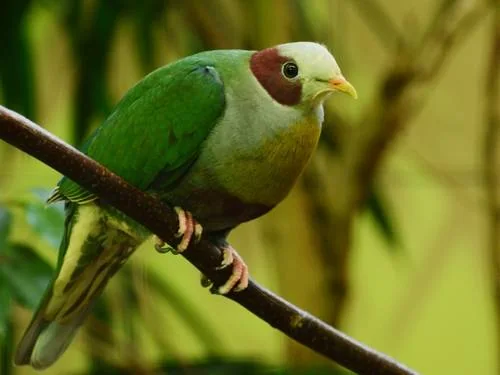
The Yellow-breasted Fruit Dove (Ramphiculus occipitalis) is a large Philippine endemic with a yellowish breast, chestnut ear coverts and purple nape. Two subspecies are recognised. The small project stock is growing through good breeding results.
- Distribution
- The Philippines except Palawan and several western peripheral islands, from Luzon through the Visayas to Mindanao.
- Size / characteristics
- about 28–33 cm | yellowish breast, chestnut ear coverts and sides of head, and purple nape; female generally greener and less contrasting
- Status
- Small stock growing through good breeding results
Description
The Yellow-breasted Fruit Dove has a distinctive plumage pattern that differs in intensity between the sexes. The yellowish breast, warm chestnut sides of the head and purple nape are especially noticeable, while females are greener and less contrasting overall. The species is widespread in the Philippines but absent from Palawan and some peripheral islands. Two subspecies occupy the northern-central and southern parts of the range. The growing project stock should continue to be managed closely by origin and pedigree.
Profile & short facts for Yellow-breasted Fruit Dove
| English name | Yellow-breasted Fruit Dove |
|---|---|
| German name | Gelbbrust-Fruchttaube |
| Scientific name | Ramphiculus occipitalis |
| Genus | Ramphiculus |
| Category | Ptilinopus - fruit doves |
| Distribution | The Philippines except Palawan and several western peripheral islands, from Luzon through the Visayas to Mindanao. |
| Subspecies | Ramphiculus o. occipitalis – northern and central Philippines from Luzon to the Visayas | Ramphiculus o. incognitus – southern Philippines, especially Mindanao and neighbouring islands. |
| Size / characteristics | about 28–33 cm | yellowish breast, chestnut ear coverts and sides of head, and purple nape; female generally greener and less contrasting |
| Status | Small stock growing through good breeding results |
| Synonyms | Ptilinopus occipitalis |
Habitat and natural range
Primary and mature secondary lowland, hill and montane forest and wooded transition zones.
Feeding in the European Fruit Dove Project
The species feeds mainly on fruit and berries taken in the canopy. In human care, a varied selection of suitable fruits should be combined with a balanced complementary food for frugivorous pigeons. In a small growing stock, food intake, body weight and condition should be documented regularly.
Husbandry in the European Fruit Dove Project
This robust forest pigeon requires a spacious, densely structured and permanently frost-free aviary with open flight paths, stable elevated perches and protected retreat areas. Multiple feeding sites and visual screening help reduce disturbance and competition during pair formation and breeding.
Breeding and offspring
Quiet, elevated and well-screened nest sites with suitable twig material should be offered. As the project stock is growing through good breeding results, successful pairings, pedigree, laying, hatching and juvenile development should be recorded completely.
Subspecies and systematics
Ramphiculus o. occipitalis – northern and central Philippines from Luzon to the Visayas | Ramphiculus o. incognitus – southern Philippines, especially Mindanao and neighbouring islands.
Special notes on the species
The combination of a yellowish breast, chestnut sides of the head and purple nape makes the species particularly striking. It is endemic to the Philippines.
Conservation status
| IUCN | Least Concern |
|---|---|
| CITES | Not listed |
| EU species protection | Not listed |
| Ring size | 8,0 mm |
Further sources
Images of the Yellow-breasted Fruit Dove
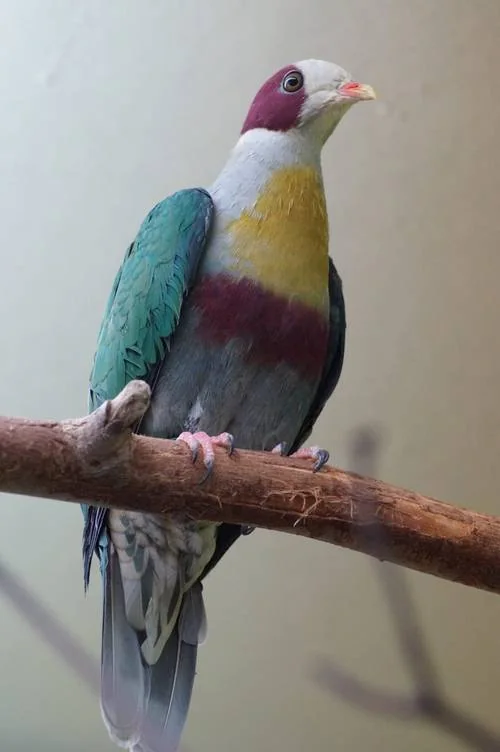
Image credits
- Gelbbrust-Fruchttaube im Kölner Zoo (© Thomas Breuer)
- Gelbbrust-Fruchttaube im Kölner Zoo (© Johannes Pfleiderer)