Fruit dove profile
Pink-spotted Fruit Dove (Ptilinopus perlatus)
Species at a glance
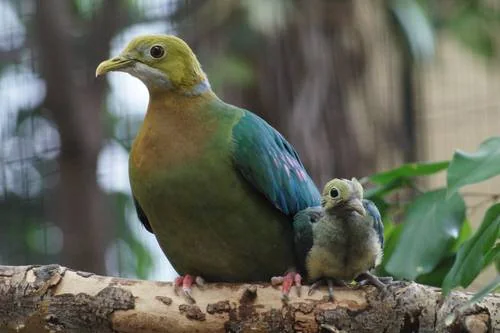
The Pink-spotted Fruit Dove (Ptilinopus perlatus) is a large fruit dove of New Guinea with an olive-green head, pale throat and conspicuous pink spots on the wing coverts. Three subspecies occupy different regions of New Guinea and several offshore island groups. The project stock is small.
- Distribution
- New Guinea and the western Papuan islands, Aru Islands, Yapen and the D'Entrecasteaux Archipelago.
- Size / characteristics
- about 25–27 cm | olive-green head, pale throat, grey to bronze breast and pink spots on the wing coverts | sexes externally similar
- Status
- Project stock small
Description
The Pink-spotted Fruit Dove is readily identified by the pink spots on its wing coverts and its pale to whitish throat. The remaining plumage combines olive-green, grey and bronze tones. Males and females are externally similar. Three subspecies are distributed across western, northern and southern New Guinea and neighbouring island groups. The species may gather in small groups at abundant fruiting trees. The small project stock should be managed carefully by origin, subspecies and pedigree.
Profile & short facts for Pink-spotted Fruit Dove
| English name | Pink-spotted Fruit Dove |
|---|---|
| German name | Perlenfruchttaube |
| Scientific name | Ptilinopus perlatus |
| Genus | Ptilinopus |
| Category | Ptilinopus - fruit doves |
| Distribution | New Guinea and the western Papuan islands, Aru Islands, Yapen and the D'Entrecasteaux Archipelago. |
| Subspecies | Ptilinopus p. perlatus – western Papuan islands and northwestern New Guinea | P. p. plumbeicollis – northern and northeastern New Guinea | P. p. zonurus – southern New Guinea, the Aru Islands and the D'Entrecasteaux Archipelago. |
| Size / characteristics | about 25–27 cm | olive-green head, pale throat, grey to bronze breast and pink spots on the wing coverts | sexes externally similar |
| Status | Project stock small |
Habitat and natural range
Tropical lowland and hill forest, forest edges, mature secondary woodland, gallery forest and wooded cultivated landscapes.
Feeding in the European Fruit Dove Project
The species feeds mainly on fruit and berries and also takes medium-sized tree fruits. In human care, a varied fruit ration should be combined with a balanced complementary food for frugivorous pigeons. In larger fruit doves, body weight, condition and food intake should be monitored regularly.
Husbandry in the European Fruit Dove Project
This robust species requires a spacious, well-structured and permanently frost-free aviary with open flight paths, stable elevated perches and protected retreat areas. Multiple feeding and escape sites help limit competition when small groups are housed.
Breeding and offspring
Quiet, elevated and load-bearing nest sites with suitable twig material should be offered. In the small project stock, subspecies, origin, pair formation, pedigree, laying, hatching and juvenile development must be documented completely.
Subspecies and systematics
Ptilinopus p. perlatus – western Papuan islands and northwestern New Guinea | P. p. plumbeicollis – northern and northeastern New Guinea | P. p. zonurus – southern New Guinea, the Aru Islands and the D'Entrecasteaux Archipelago.
Special notes on the species
The pink spots on the wing coverts appear pearl-like at close range and inspired the German common name. The species may form small groups at fruiting trees.
Conservation status
| IUCN | Least Concern |
|---|---|
| CITES | Not listed |
| EU species protection | Not listed |
| Ring size | 8,0 mm |
Further sources
Images of the Pink-spotted Fruit Dove
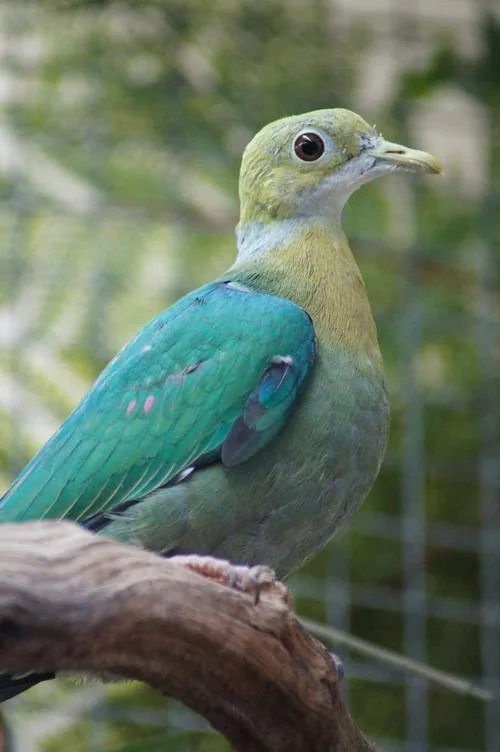
Image credits
Perlenfruchttaube im Zoo Köln (© Thomas Breuer)